
November 23, 2026
Vulnerabilities3 min. read
Seen before the warning: attacks on exploited vulnerabilities recorded by Nothreat digital twins
A sample from autumn 2026: five vulnerabilities that CISA later confirmed as exploited. Attacks on four of them reached Nothreat CyberEcho digital twins before CISA's alert, one 21 days earlier.
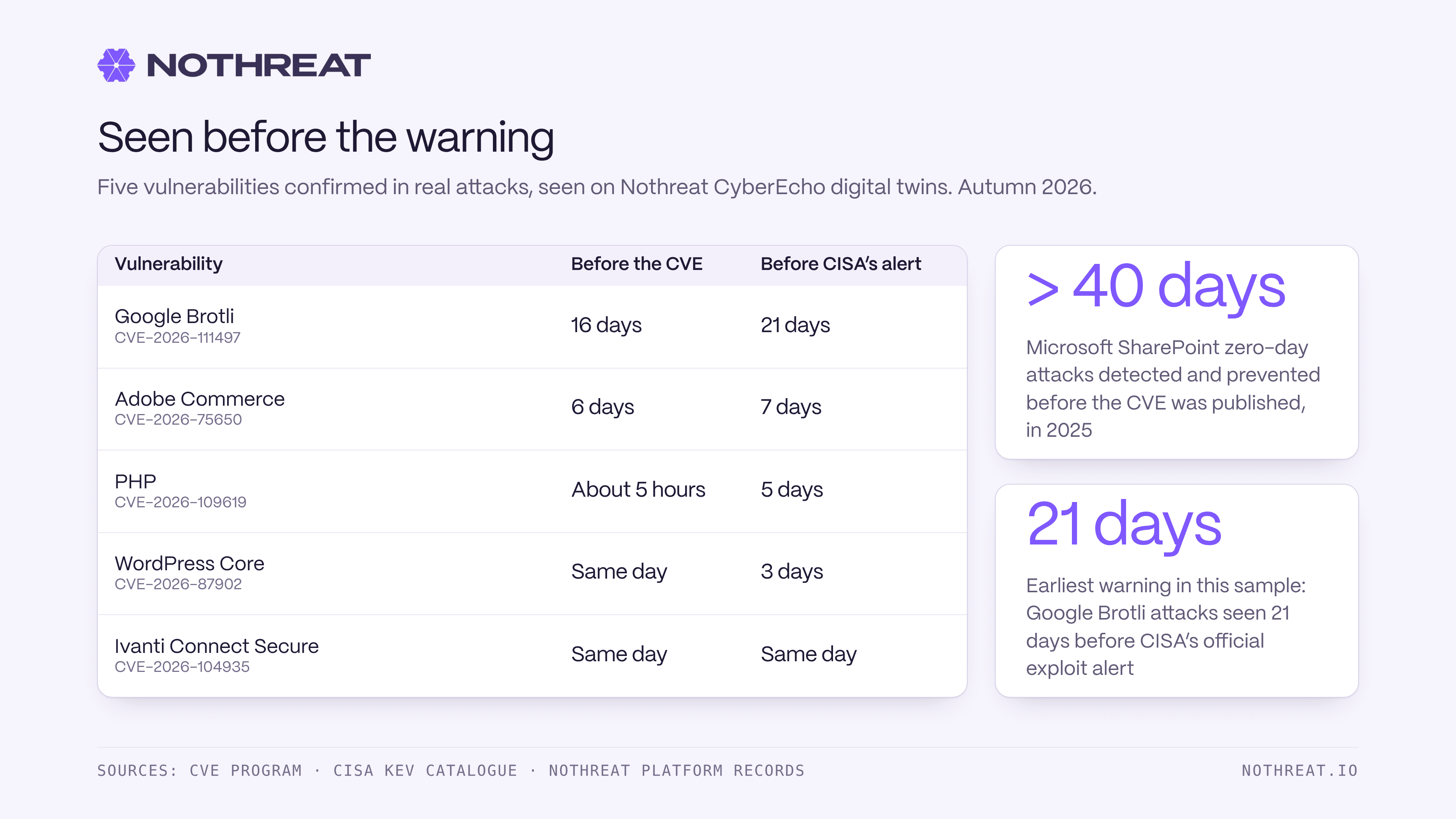
Attacks on four of the five reached Nothreat CyberEcho digital twins before CISA added the vulnerability to its Known Exploited Vulnerabilities (KEV) catalogue, and on three before the CVE Program published the CVE record. The twins saw the fifth on the day of both.
Vulnerability | CVE | CVE published | Added to CISA KEV | Seen before the CVE | Seen before CISA's alert |
Google Brotli | 22 October 2026 | 16 days | 21 days | ||
Adobe Commerce | 7 September 2026 | 6 days | 7 days | ||
PHP | 21 October 2026 | About 5 hours | 5 days | ||
WordPress Core | 22 September 2026 | Same day | 3 days | ||
Ivanti Connect Secure | 13 October 2026 | Same day | Same day |
How to read the table
- Seen means the first attack traffic for that vulnerability that Nothreat CyberEcho digital twins at Nothreat customers recorded.
- Before the CVE counts the time from that first record until the CVE Program published the CVE record.
- Before CISA's alert counts the time from that first record until CISA added the vulnerability to KEV. CISA adds a vulnerability to KEV when it has evidence of exploitation in real attacks.
The public dates come from the CVE records and the KEV catalogue, both linked in the table. All times are UTC.
Why digital twins see it early
A digital twin is a decoy copy of a service that stands in a customer's network or on the Internet as one more server. It has no legitimate users, so every request it receives is hostile. The Nothreat Platform checks whether the content is new and whether it arrives from unrelated networks. Neither check needs a signature, an advisory or a CVE record.
What this means for a business
A company is exposed from the day attacks start until the day it applies the patch. In that period the Nothreat Platform turns the twins' records into a verdict on each attacker. Nothreat ThreatShield applies the verdict through the firewalls and WAFs the customer already runs, under the customer's policy (block, alert or hand off).
What this sample does and does not show
This note shows part of what the twins recorded. The records come from twins at customers who share intelligence through Crowd Immunity, so they cover one vantage point. We cannot say how many real servers received the same traffic. Lead times in the sample run from the same day to 21 days.
Earlier records
Our PHP2Shell note describes the PHP row hour by hour. In 2025 Nothreat detected and blocked the SharePoint ToolShell exploit more than 40 days before Microsoft published CVE-2025-53770. The SharePoint case study has the detail.
Nothreat CyberEcho digital twins are part of the Nothreat Platform. See how they work on the CyberEcho page, or book a demo.
Sources: CVE records (CVE Program) · CISA Known Exploited Vulnerabilities catalogue, version 2026.11.20.